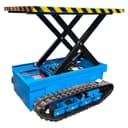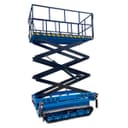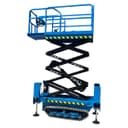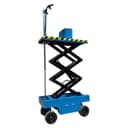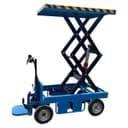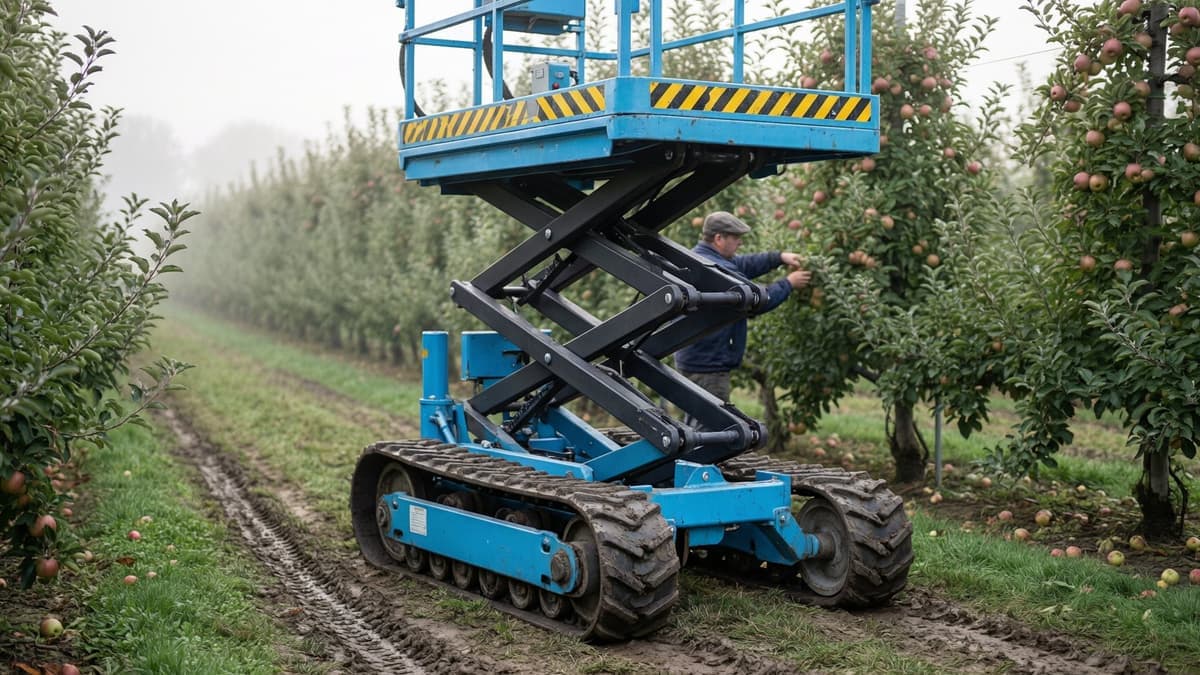
The lift mechanism is the same on almost every machine we build. What changes, and what decides where you can actually use it, is the part that touches the ground. Our eighteen models fall into three groups: rubber tracks, solid rubber tyres, and tracks with hydraulic outriggers.
Reinforced rubber tracks, dual motor drive. Six models, working heights from 1.2 m to 6 m.
Solid rubber tyres, self propelled. Nine models in two families: the poultry house range (1.2 m to 4 m) and the stand on range (2 m to 6 m).
Tracks plus four point hydraulic outriggers. One model, the 5 m crawler with self levelling legs.
Tracks
A track spreads the machine over a much longer footprint and puts the drive onto ground that does not have to be flat. Our crawler models are listed for orchard rows, building sites and unsealed ground, which is what they are built for. The 1.2 m and 2 m models add a 360° spot turn on the wireless remote, so the machine can pivot in its own length between tree rows instead of doing a three point turn on soft ground.
What tracks cost you is width and weight.
Model | Undercarriage | Packed width | Machine weight |
|---|---|---|---|
Crawler scissor 1.2 m | Reinforced rubber tracks | 1,020 mm | approx. 350 kg |
Crawler scissor 4 m | Reinforced rubber tracks | 1,120 mm | approx. 620 kg |
Crawler scissor 6 m | Reinforced rubber tracks | 1,120 mm | approx. 780 kg |
Poultry house lift 1.2 m | Solid rubber tyres | 720 mm | approx. 270 kg |
Stand on scissor 2 m | Solid rubber tyres | 820 mm | approx. 340 kg |
Solid tyres
The tyre models are narrower and lighter. The poultry house range packs between 720 mm and 920 mm wide against the crawler's 1,020 mm to 1,320 mm, and the lightest machine in the catalogue, at about 270 kg, is a 1.2 m poultry lift. That width difference is usually the deciding fact: a 720 mm machine goes down a barn aisle that a 1,020 mm machine does not.
Four of the poultry models publish an operating temperature of -10 °C to +40 °C, which is the range they are built and tested in. If your site sits outside it, say so in the inquiry rather than finding out in January.
The trade is the contact patch. A tyre puts the whole load through four small footprints, which is fine on a finished floor and bad on soft ground. If your building has a point load limit per square metre, ask us for the wheel loads and check them with your structural engineer before the machine arrives.
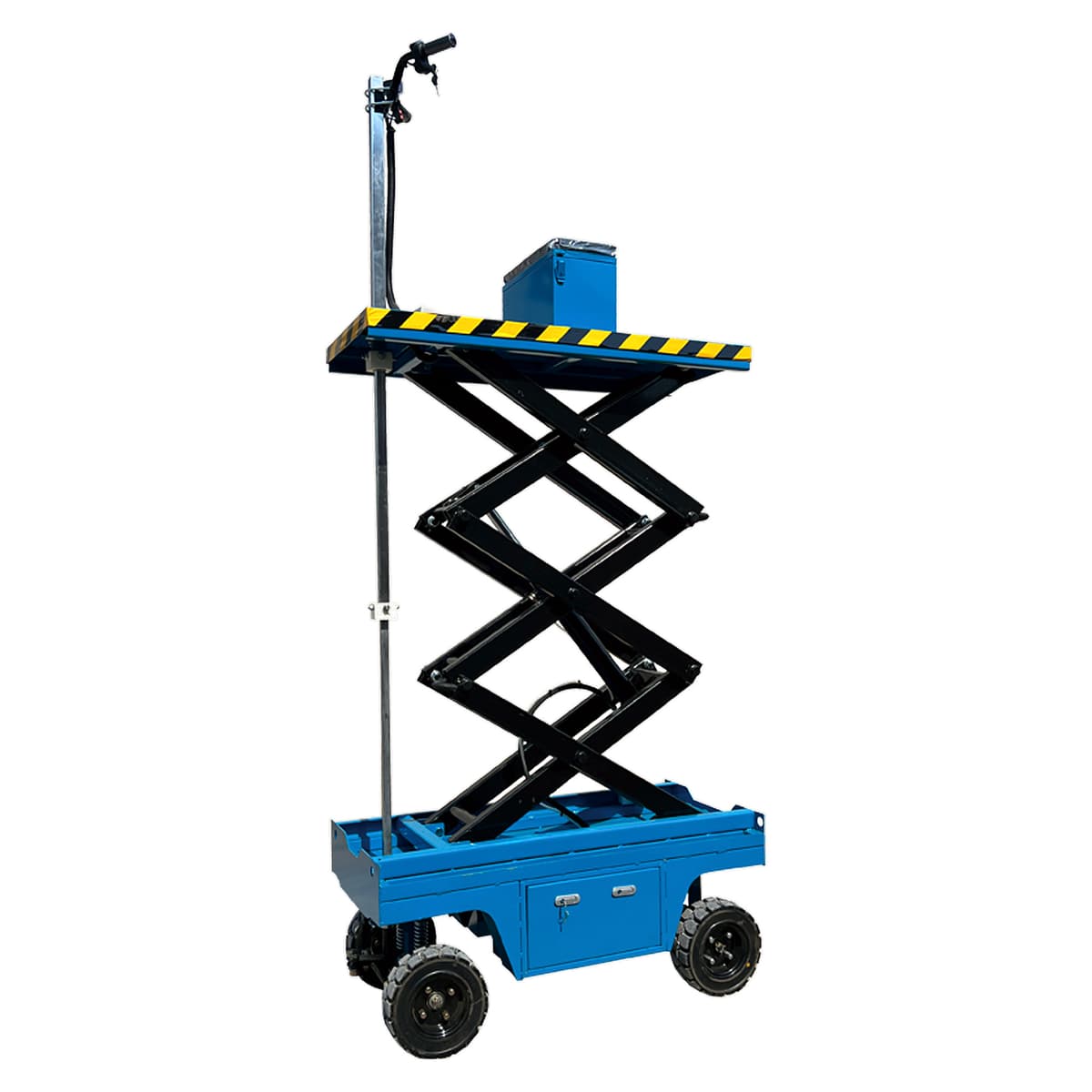
Outriggers
The 5 m crawler with outriggers does the same job with a different stance: four point hydraulic outriggers, self levelling. It is heavier and slower to reposition than the standard 5 m crawler, and the numbers show exactly what you are paying for.
Item | Standard 5 m crawler | 5 m crawler with outriggers |
|---|---|---|
Machine weight | approx. 720 kg | approx. 1,150 kg |
Motor | 1,500 W brushless | 2,200 W AC |
Folded height | 850 mm | 970 mm |
Guardrail | 800 mm detachable | 800 mm fixed |
Deck | 1,700 × 1,000 mm | 1,500 × 900 mm plus a 600 × 650 mm extension |
You pay in setup time and in 430 kg of extra weight. You get a machine that stands level on ground that is not level, and a deck that extends 650 mm out for long material. If you move every few minutes, take the standard crawler. If you park for a whole shift and need the deck dead level, this is the one.
One thing to check before you order: the legs deploy outward from the chassis, so the machine needs clear floor at all four corners, not just under it. The packed width is 1,070 mm and the outrigger pads sit outside that.
How to choose
What is under the machine for the whole shift: unsealed ground, grass, orchard rows, or a finished floor.
What it has to pass through: doors, barn aisles, lift cages, container doors. Compare against the packed width in the table above.
How often it moves while loaded, because that is what separates the outrigger model from the rest.
Related: how to read the three heights on a spec sheet, and the crawler range.